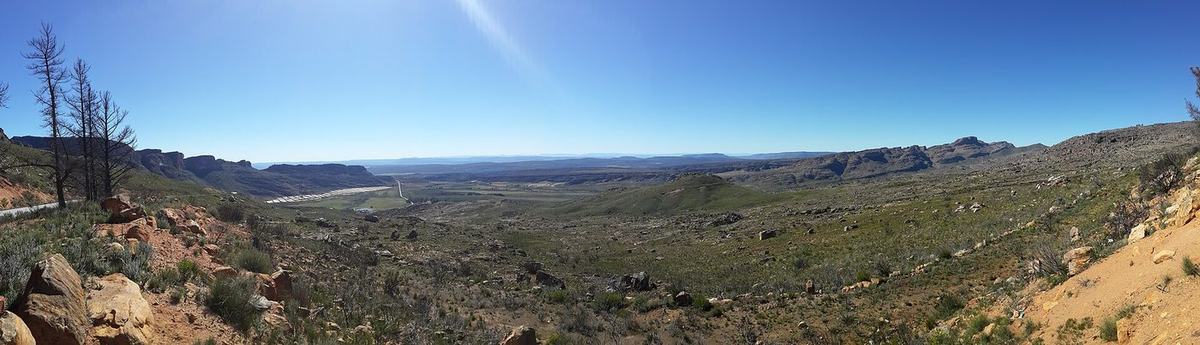
This is the page we would want to read before driving in: when to come, how long to stay, what the road is really like, and what you must bring with you.
When to come, month by month
Wupperthal has a Mediterranean climate turned up loud: hot, bone-dry summers and cold, wet winters, with snow on the high Cederberg peaks in the coldest weeks. What that means in practice, month by month:
| Month | Weather | What's on, and what to expect |
|---|---|---|
| January | High summer. Hot and dry. | Rooibos harvest under way on the slopes. Walk at dawn or not at all. River pools low. Busy in the first half with South African holidays. |
| February | Hottest and driest. | Harvest continues. Not the month for long hikes. Quiet once schools go back. |
| March | Heat easing, still dry. | Harvest finishing. Excellent driving weather, long light, very few visitors. An underrated month. |
| April | Mild days, cool nights. First rain possible. | Some of the best hiking of the year. Easter fills the village with family and the cottages with visitors — book ahead. |
| May | Cool. Rain starting in earnest. | The valley greens up. Very quiet. Take a warm layer and watch the road after rain. |
| June | Winter. Cold and wet, snow possible on the peaks. | Dramatic and empty. Gravel roads soften and the roads past the village get difficult. Clear winter days here are magnificent. |
| July | Coldest and wettest. | The river runs hard and the waterfalls are at their best. The first flowers can show late in the month. Worst month for the gravel. |
| August | Cold mornings, warming days. | Flower season. The Biedouw valley and the veld on the road in fill with daisies. The busiest weeks of the year on this road — book accommodation well ahead. |
| September | Mild and green. | Flowers into the first week or two, rivers still full, swimming starts, best all-round hiking. Our pick of the year. |
| October | Warm, drying out. | Superb walking, water still in the pools, and quiet again after the flower crowds. Our other pick. |
| November | Warm to hot, dry. | Long evenings and the best of the night skies. Start walks early. |
| December | Hot and dry. | Festive season: families come home, the church is full, and Christmas is the village's own. Accommodation is scarce — book long in advance and expect a working village at its busiest. |
The flower-season dates are sourced (see the flower season guide); the rooibos harvest is described by the co-operative as a summer job. The rest of this table is our reading of the region's climate and rhythm rather than a reading from a village weather station — treat it as a guide, and check a forecast before you drive.
How long to stay, and what to do with the time
One day, from Clanwilliam
- 08:00
Leave Clanwilliam
Fuel, cash and water first. Out on the R364 over the tarred Pakhuis Pass — stop at the top for the view, it costs you ten minutes.
- 09:00
Turn at the Englishman's Grave
Roughly 40 km along the R364. From here it is about 40 minutes of gravel down into the Tra-Tra valley. Slow down for oncoming traffic and for donkeys.
- 10:00
The village
Park and walk. The shoe factory, the church, Die Werf and the Mission Store, the street. Two hours, unhurried.
- 12:30
Lunch at Lekkerbekkie
In the Mission Store on Die Werf. Phone ahead if you can — it is a community kitchen, not a restaurant chain.
- 14:00
Start back
Leave enough daylight. Gravel roads and dusk and unfenced livestock are a bad combination, and you do not want to meet the pass in the dark.
Two days — the one we would do
Day one
Drive in, do the village slowly, lunch at Lekkerbekkie, and settle into a cottage. Late afternoon: walk up out of the village for the view back down over the roofs. After dark, go outside and look up.
Day two
Out early on the gravel to Eselbank — the waterfall, the viewpoints, the rock arch — then back through the village for the road home, with the Sevilla rock art trail at Traveller's Rest on the way out if you still have legs. Check your car is up to the Eselbank road first.
Three days or more
Add the mountains
Either the Heuningvlei donkey cart trail from the Pakhuis Pass, staying over in the community lodge, or a permitted day hike into the Cederberg Wilderness from Kliphuis. Both need booking, and the wilderness needs a CapeNature permit.
Add the outstations
Langkloof, Beukeskraal, Kleinvlei — a whole morning of gravel and almost no one else. This is where the valley stops being a destination and becomes a place.
Add the Biedouw
In August and early September, go out over the Biedouw valley rather than straight back to Clanwilliam. In a good flower year it is the best hour of the trip.
The road, and whether your car will manage
The honest version, because getting this wrong spoils trips.
To the village: from Clanwilliam you take the R364 over the Pakhuis Pass, which is tarred. About 40 km out you turn off at the Englishman's Grave, and from there it is roughly 40 minutes of gravel down into the valley. In dry weather an ordinary car does this perfectly well if you drive it gently — reduce speed, watch for washboard corrugation and loose gravel on the bends, and give oncoming vehicles a wide berth and your dust.
Beyond the village: a different road altogether. The tracks south and east — toward Eselbank, the waterfall, Hoek se Berg and on to Matjiesrivier — are rocky and steep in places. Sources that drive them for a living advise high clearance rather than a sedan, and rate a 4x4 as mandatory in the wet season. The Tra-Tra trail east of the village is a genuine off-road route with river crossings, for experienced drivers only.
Drop your tyre pressure a little for gravel and put it back on the tar. Check the spare and the jack before you leave town. Drive at a speed where you could stop for a goat. Do not travel the gravel at night. And after heavy rain, ask someone local before you commit to anything past the village.
Before you leave Clanwilliam
Clanwilliam is the last town with fuel, a bank, a pharmacy and a supermarket. Work down this list there, not here.
- Fill the tank There is no fuel in Wupperthal, and none between.
- Draw cash No ATM in the village. Cash for the factory, the shop and lunch.
- Water More than you think. The Cederberg is dry and shadeless.
- Food, if self-catering The Mission Store carries basics and cold drinks, not a week's shopping.
- Download the map offline Signal is patchy and there are real dead zones.
- Check the spare, jack and tyre pressure A puncture on gravel is the most likely thing to go wrong.
- Sun protection Hat, sunblock, sunglasses. There is no shade on the trails.
- A warm layer Nights in the mountains are cold in every season.
- A torch or headlamp Village lighting is minimal, and that is a feature.
- Medication and a basic first-aid kit The nearest pharmacy and hospital are back in Clanwilliam.
- A hiking permit If you are going into the Cederberg Wilderness — from Kliphuis on the pass.
- A bag for your rubbish Take out what you bring in.
- Tell someone your plan Your route and when you expect to be back in signal.
How to be a good visitor
Roughly 700 people live here. The cottages you are photographing are their houses, and the yard you are standing in is where their children play. None of this is complicated:
- Drive at a walking pace through the village. Dust and speed are the two things visitors get wrong most often.
- Ask before you photograph people, their homes or their children — and accept no as an answer.
- Greet. Afrikaans is the language of the valley. Goeiedag goes a long way, and dankie even further.
- Buy locally, directly. Vellies at the factory, rooibos from the co-op, lunch at Lekkerbekkie, honey and tea and whatever else is offered at a door. That is the whole economic point of your visit.
- Respect Sunday. It is a church village and Sunday morning belongs to the church. Visitors are welcome at the service; dress as you would at home.
- Keep the volume down. No sound systems in the yard, no drone buzzing over people's roofs.
- It is not a museum. Nobody here is in costume, and the buildings are not exhibits. Behave as a guest in someone's village, because that is what you are.
Tourism information: where to ask
There is no formal Wupperthal tourism bureau or visitor centre in the village — tourism here is run informally by the community. In practice, the people to ask are:
- The Mission Store on Die Werf — the village's shop and the closest thing to a tourism information point, where Lekkerbekkie is also based.
- The shoe factory — the workshop sells vellies at the door and its staff know the village and the valley.
- Your accommodation host — cottage, farm stay or campsite hosts are the best source of current, local advice.
- The Cederberg tourism association and CapeNature — for the wider Cederberg, permits and the Heuningvlei donkey cart trail, book through the Cederberg Heritage Route.
For planning before you arrive, this site is the practical guide: the getting here page covers the road, where to stay covers accommodation, and the valley map plots the village, factory, outstations and passes.
Questions people actually ask
How long do you need in Wupperthal?
An afternoon does the village. A night lets you see the valley properly, and see the stars. Two nights is the sweet spot if you want the waterfall and an outstation as well.
Do you need a 4x4?
Not to reach the village — the pass is tarred and the last stretch is maintained gravel that an ordinary car handles in dry weather. Yes, effectively, for the roads beyond the village in the wet, and for the Tra-Tra trail at any time.
Is there anywhere to eat?
Lekkerbekkie, the community-run restaurant and tea room in the Mission Store on Die Werf, plus the Wupperthal Cafe. Hours are informal, so phone ahead. More here.
Is there fuel, an ATM or a supermarket?
No, no and no. Clanwilliam, about 75 km back, is where you do all three.
Will my phone work?
Sometimes, in parts of the village. The wider Cederberg has significant dead areas. Download maps before you leave and do not count on being contactable.
Can I buy vellies at the factory, and what do they cost?
Yes — shoes are sold at the workshop, and buying a pair there is the single most direct way to put money into this village. We do not publish prices because we cannot verify them and they change; take cash and ask at the door.
Can I go to a church service?
Yes. The Moravian congregation still worships in the thatched church and visitors are welcome. Arrive early, dress respectfully, and put your phone away.
Will I see riel dancing?
Only if something is on. Die Nuwe Graskoue Trappers are a competitive troupe of young dancers, not a hotel floor show, and they perform at events and competitions. Ask locally, and if you get the chance, take it. Their story.
Is it safe?
The risks here are practical rather than criminal: the gravel road, the heat, dehydration, hiking without water, swimming alone, and driving at night. Treat the mountains seriously and you will be fine.
Can I camp or bring a caravan?
Camping exists in the area, but pitches and facilities need confirming with whoever runs them — and towing a caravan down the last stretch of gravel is not something we would do. See the accommodation page.
Is Wupperthal a good trip with children?
Yes, with the caveats that the drive is long and unpaved and nothing here is fenced. River pools, donkeys, mountains and a shoe factory tend to beat a screen.
What about accessibility?
The village core is compact and mostly level, but the surfaces are gravel and sand, the buildings are historic, and there is little formal provision. Phone your hosts in advance and ask directly — you will get an honest answer.
Is alcohol sold in the village?
Not something we can confirm, and this is a mission village — assume not, and be discreet with whatever you bring for your own cottage.
Can I get there without a car?
Not easily. There is no scheduled public transport into the valley. The practical no-car options are a guided Cederberg Heritage Route trail, which includes transfers from Clanwilliam, or arranging a transfer with your accommodation.
Last updated August 2026 · road conditions, hours and prices change — confirm locally